Why does Bill Gates call AI more dangerous than nuclear weapons?
Need articles like this for your video? They help promote it on YouTube and Google — order them in the Telegram bot @sat_sit_bot. Articles with your video embedded are written and posted by the bot itself — on popular topical sites (no ads). Free trial — 50 articles.
· based on the channel The Ezra Klein Show
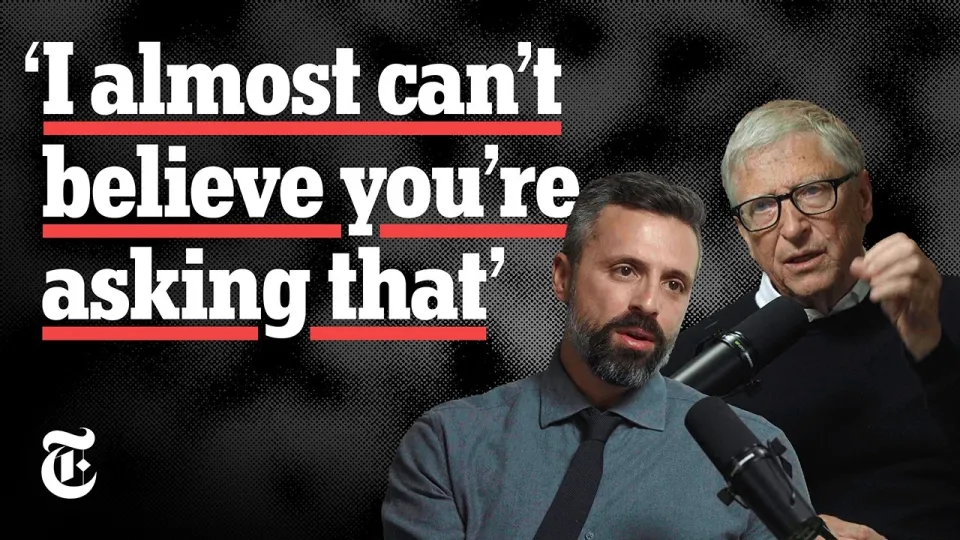
Bill Gates argues that artificial intelligence is the most dangerous technology humanity has ever approached, and that the danger is larger than the nuclear arsenals that defined the last century. In his conversation with Ezra Klein, he says the AI industry cannot police itself, that governments are in denial about what is coming, and that catastrophic cyberattacks, bio-terrorism and mass job loss are realistic near-term outcomes unless policy catches up. The full interview and transcript are available through The Ezra Klein Show episode page.
Why does Gates rank AI above nuclear weapons?
Gates frames AI as a general-purpose technology whose failure modes scale faster than the institutions built to contain them. Nuclear weapons are bounded by physics, treaties and a small number of state custodians; AI is software that spreads instantly, improves recursively and sits in the hands of private companies and individuals. That asymmetry is the core of his argument: the same model that helps design a drug can help design a pathogen, and the same agent that defends a network can probe one.
He also draws a line between capability and governance. The risk is not only that models become powerful, but that the people with authority to regulate them do not believe the threat is real. In the interview he is visibly more alarmed than in past appearances, and he pushes back hard on the idea that markets or reputations will discipline AI labs before something irreversible happens.
What are the cyber and bio thresholds Gates describes?
Gates points to two thresholds where AI changes the math of harm: offensive cyber and biological weapons. On cyber, he expects AI-driven attacks on critical infrastructure — power grids, financial systems, hospitals — that move faster than human defenders can respond. On bio, he warns that AI could lower the skill barrier for designing dangerous biological agents, turning what once required a state laboratory into something a small group could attempt.
The reason these thresholds matter is scale. A single catastrophic event in either domain could kill on a magnitude that no court, insurance market or reputational mechanism can absorb after the fact. That is why Gates rejects the idea that liability and litigation are an adequate backstop: you cannot sue your way out of a mass-casualty event. Prevention, in his view, has to happen before deployment, through licensing, testing and hard limits on what frontier systems are allowed to do.
Why does Gates call AI self-regulation insane?
Gates says the notion that AI companies will regulate themselves is "insane," and the interview makes the case in practical terms. Self-regulation depends on the regulated party correctly estimating risk, disclosing it honestly and accepting costs that competitors will not. In a race, every one of those incentives points the other way.
His alternative borrows from other safety-critical industries:
- Government licensing for frontier models, with pre-deployment evaluation rather than post-hoc review.
- Mandatory incident reporting, so failures become public data instead of private lessons.
- Independent auditors with access to weights, training data and evaluation results.
- International coordination, because a model trained in one country can be used in another.
- Liability that survives corporate restructuring, so accountability does not dissolve when a lab reorganizes.
Gates is explicit that speed matters. Regulation written after a disaster is a postmortem, not a policy, and the window for getting rules in place closes as capability improves.
How will AI disrupt jobs and the global economy?
Gates expects AI to compress white-collar work faster than previous automation waves compressed manufacturing. Tasks that involve reading, summarizing, coding, drafting and analysis are exposed first, and the affected workers are concentrated in sectors with strong political voice. He does not treat this as a distant scenario; he describes a transition that could arrive within a few years rather than a generation.
His responses fall into three buckets. First, a no-scarcity job market: if AI lowers the cost of goods and services substantially, the policy question becomes distribution rather than employment alone. Second, taxing AI labor, an idea he raises as a way to fund transition support when machine output replaces payroll taxes. Third, "human reserved" jobs, roles where people explicitly want a human on the other end — care, education, some public services — and where regulation can protect that preference.
He is equally concerned about developing nations. If AI raises productivity in rich countries while leaving low-income economies without compute, data or skills, the gap widens rather than closes. That is why the Gates Foundation has made AI-driven inequality a new priority, alongside its plans to spend down roughly $200 billion over the next two decades.
What do skeptics get wrong about AI risk?
The most common objection is that alarm about AI is overblown, and that markets already punish companies that ship harmful products. Gates's answer is that the feedback loop is too slow. Reputational damage takes years; a cyber or bio incident takes hours. Capitalism does provide incentives, but it provides them to move fast and to underreport risk, which is exactly the wrong direction for a technology with irreversible failure modes.
A second objection is that regulation will hand the advantage to China. Gates takes the strategic competition seriously — he does not dismiss the race — but argues that a race without shared safety floors is a race to the bottom. Coordination on thresholds, reporting and dangerous-capability testing is not a concession to a rival; it is the only way either side avoids an outcome that damages both.
A third objection concerns children and education. Gates is optimistic about AI tutoring, especially where good teachers are scarce, but he is blunt about learning loss in rich countries and about the need for age-specific rules: what a model may say to a child, how it handles personal data, and what schools should require before adopting it.
Useful links
- Full episode and transcript of Bill Gates on The Ezra Klein Show — the primary source for this analysis.
- Book recommendations from Ezra Klein Show guests — a running list maintained by the show.
The bottom line
Gates's position is not that AI should be stopped, but that it is being deployed faster than the institutions meant to contain it can adapt. His list of concerns — cyber, bio, jobs, inequality, children — is a policy agenda rather than a prediction, and the interview's value is that it treats each item as a decision still open. The tone is what makes it notable: a technologist who spent a career betting on software now arguing that the burden of proof has shifted to the people building it. This analysis is based on the conversation published by The Ezra Klein Show, and the episode itself is worth hearing in full for the exchanges that a summary cannot capture.
Key takeaways
- Gates says AI is the most dangerous technology humanity has approached, ranking the threat above nuclear weapons.
- He calls industry self-regulation of AI "insane" and argues courts and lawsuits cannot handle mass-casualty failures.
- Two thresholds worry him most: AI-enabled cyberattacks and bio-terrorism that could kill on a scale no legal system can address.
- The Gates Foundation plans to spend down roughly $200 billion over two decades, with AI-driven inequality as a new priority.
- He expects mass job disruption and floats ideas such as taxing AI labor and "human reserved" roles.
Questions & answers
Is Bill Gates against AI development?
No. Gates argues for regulated development, not a moratorium. He is optimistic about AI in medicine, education and productivity, but insists that frontier models need licensing, testing and reporting before deployment rather than after a failure.
Why does Gates think lawsuits cannot handle AI harm?
Because liability operates after the damage is done. For a mass-casualty cyber or bio event, no settlement or court judgment restores what was lost, so prevention through pre-deployment rules is the only workable safeguard.
What does taxing AI labor mean in practice?
It means adjusting the tax base when machine output replaces payroll. If income and social insurance are funded through human wages, a shift toward AI production erodes that base, so Gates raises taxing AI-driven output as one way to fund transition support.
How does the Gates Foundation plan to address AI inequality?
The foundation intends to spend down roughly $200 billion over two decades, with AI-driven inequality named as a new priority. The focus is on making sure low-income countries get access to the productivity gains rather than being left behind.
Source: Bill Gates: A.I. ‘Makes Nuclear Weapons Look Like Nothing’ | The Ezra Klein Show · Markdown version